
CAO Status Check 2027: Tracking Your CAO Application Status
CAO Status Check 2027. Applying through the Central Applications Office can feel like a waiting game but you don’t have to sit in the dark wondering what’s happening with your application. In 2027, checking your CAO status takes just a couple of minutes from your phone or laptop and you’ll instantly know exactly where things stand whether you’ve landed a firm offer, need to submit an extra document or your file is still under review.
This guide walks you through the entire process step by step explains every status message you might see, breaks down the application fees and payment options.
What Is the Central Applications Office (CAO)?
The Central Applications Office, better known as CAO, is the organization that manages undergraduate course applications for universities and colleges. Instead of applying separately to every institution you’re interested in, CAO lets you submit one single application that reaches multiple schools at once. On top of processing applications, CAO also runs the points-based ranking system used to sort applicants when a course receives more applications than it has available seats.
Because so much rides on this one application, keeping an eye on your CAO status regularly is one of the smartest things you can do during the admissions season.
How to Check Your CAO Application Status Online
Checking your status through the CAO portal is quick and doesn’t require any paperwork. Here’s exactly how to do it:
- Go to the official CAO login page at cao.ac.za/MyApplicationLogin.aspx
- Enter one of the following identification details:
- Your CAO Number
- Your ID Number
- Your Passport Number (for international applicants)
- Click Submit
- Your current application status will load on the screen instantly
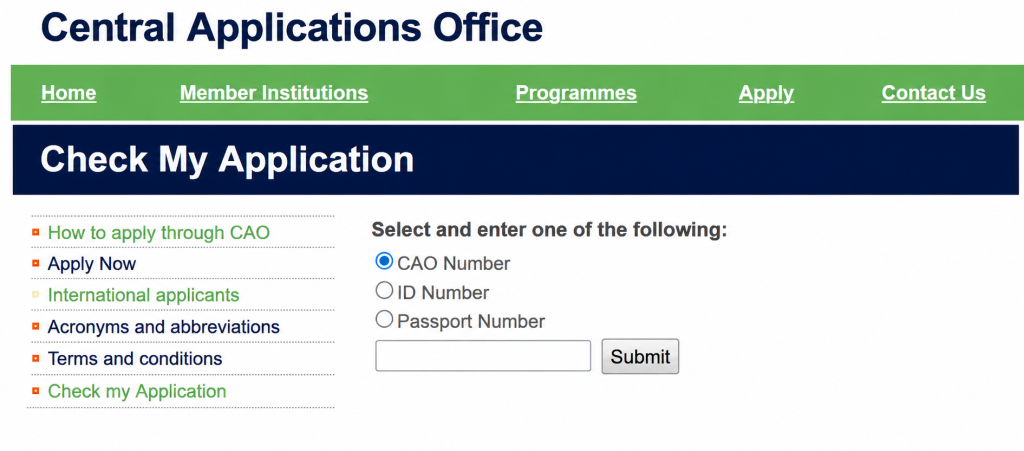
That’s the entire process no waiting on hold, no visiting an office and no need to fill out extra forms just to see where you stand.
CAO Status Check With ID Number
Follow these simple steps:
- Visit the official “Central Applications Office” website.
- Find and select “Check My Application” from the homepage or menu.
- Choose “ID Number” as your identification option.
- Enter your valid South African ID number in the required field.
- Submit the information to access your application status.
After submitting your details, the system will display the latest available information about your application and programme choices.
CAO Application Status Portal
The CAO status portal isn’t just for checking your admission progress. It’s built as a full self-service hub for applicants, giving you access to:
- Your current application status and any updates from institutions
- A complete list of available courses and course-specific PDFs
- Details on faculties and departments across participating institutions
- Admission requirements for each programme
- Prospectuses and academic brochures
- Academic calendars, term dates and registration dates
- The APS Calculator, which helps you work out your own admission points
- Application fee information and payment deadlines
Everything you need to track your journey from application to registration is available through this single portal.
CAO Application Fees in South Africa
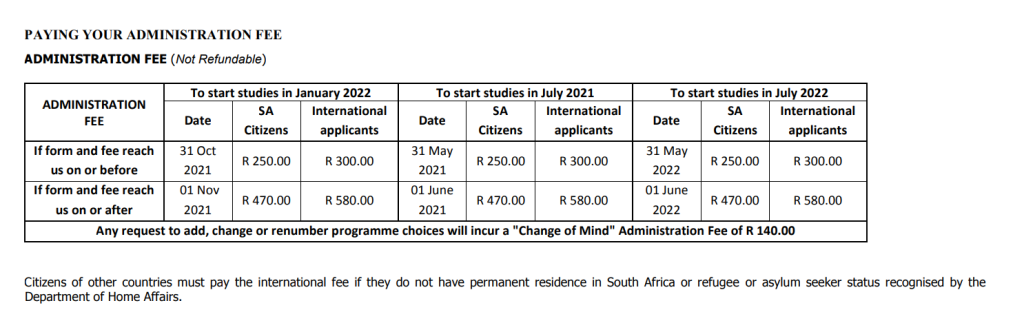
Timing matters when it comes to CAO fees, so it pays to know the numbers before you submit anything.
| Applicant Type | On-Time Fee | Late Fee |
|---|---|---|
| South African Citizens | R250 | R470 |
| International Applicants | R300 | R470 |
If your forms and supporting documents arrive after the official deadline, the higher late fee of R470 applies to both local and international applicants — so it’s worth submitting everything as early as possible.
How to Pay Your CAO Application Fee
CAO gives applicants a few flexible ways to settle their fee, depending on what’s most convenient for you.
| Payment Method | Where to Pay | Accepted Payment Types |
|---|---|---|
| EasyPay (Recommended) | Pick n Pay, Checkers, Shoprite, Woolworths or any store displaying the EasyPay sign | Cash, Debit, or Credit Card |
| Online Credit Card Payment | Visit cao.ac.za, click “My Application,” enter your CAO or ID number, and follow the prompts | Credit Card Only |
| In-Person at CAO Office | Gate 11, UKZN, Mary Thiphe Street, Cato Manor, Durban | Credit or Debit Card |
EasyPay tends to be the most popular route since it lets you pay in cash at retail stores you likely already visit regularly.
Important CAO Dates to Keep in Mind for 2027 Entry
CAO deadlines aren’t fixed across the board they depend heavily on the closing dates set by each individual institution. For example, applicants hoping to study teaching at the University of KwaZulu-Natal for the 2027 academic year need to submit their CAO application before the institution’s own cut-off date in September of the preceding year.
Because these dates vary from one institution and programme to another, it’s essential to check the specific closing date for every course you’re applying to rather than assuming one universal deadline applies to all of them. Missing a closing date doesn’t necessarily end your chances but it usually means your file gets marked as a late application, which institutions handle differently and which comes with a higher fee, covered in the next section.
How Do I Know If CAO Has Received My Documents?
If you’d like confirmation that your documents actually reached CAO, include a stamped, self-addressed postcard or envelope along with your application form. Once CAO processes your submission, they’ll mail this back to you as proof of receipt.
One important thing to understand: this acknowledgement only confirms that CAO received your paperwork. It doesn’t mean they’ve checked whether the documents are complete or accurate that verification happens separately as your application moves through the review process.
How Can I View My CAO Documents Online?
CAO scans all submitted documents electronically and uploads them to your online profile. Simply log into the “My Application” section of the CAO website and you’ll be able to view everything you’ve submitted along with your current status, directly from your account.
Understanding CAO Status Messages: What Each One Means
CAO uses specific wording to show exactly how far your application has progressed with each institution. Here’s a breakdown of what each status actually means:
- Waiting for a Decision This is the default status for applications submitted on time it simply means the institution hasn’t reviewed your file yet.
- Late Application Your application arrived after the closing date. Each institution handles late applications differently, so check the relevant prospectus for specifics.
- Awaiting Results The institution is holding off on a final decision until they receive additional results, such as your June, trial, or final NSC results.
- Conditional Offer You’ll be accepted if you meet certain requirements which, for competitive programmes, may be stricter than what’s published in official materials. Some courses may also require an assessment test during registration. Note that this offer can be withdrawn if you don’t confirm acceptance or if your final results fall short of your earlier performance.
- Firm Offer Congratulations, a place has been secured for you. Just remember that failing to accept it, or a drop in your final results compared to earlier ones, could still result in the offer being withdrawn.
- Has Not Met Programme Ranking Criteria Your application didn’t meet the specific requirements for that programme. Check the institution’s prospectus for details, and consider submitting a Change of Mind Request Form if you’d like to be considered for a different course.
- Interview/Audition/Portfolio Some programmes require an additional selection step. The institution should reach out with the date, time, and location — but it’s a good idea to follow up directly if you don’t hear back promptly.
- Please Supply Academic Record The institution needs a copy of your academic record from your current or previous tertiary studies before proceeding.
- Please Supply USAf/SAQA Evaluation If you completed exams outside South Africa, your results may need formal evaluation through Universities South Africa (USAf) or SAQA.
- Programme Closed The programme is no longer accepting or reviewing further applications.
- Refer for Decision Your application needs additional assessment before any status change can be made.
- Regret Programme Discontinued The institution has decided to stop offering this particular programme. In some cases, they may suggest an alternative course, and you can switch your application at no extra cost using a Change of Mind Request Form.
- Regret Unsuccessful Based on their selection process, the institution has decided not to offer you a place on this programme.
- Short-listed, Standby, and Wait-listed Your application is still under active consideration, but a final decision hasn’t been made yet.
- Unsuccessful Following Placement Test/Interview After reviewing the results of your entrance test or interview, the institution decided not to move forward with your application.
Does NSFAS Funding Affect Your CAO Application?
A common point of confusion for applicants is whether CAO also handles financial aid. It doesn’t. CAO and NSFAS (the National Student Financial Aid Scheme) are two completely separate systems, and CAO does not approve or process NSFAS funding in any way.
If you’re relying on financial assistance to fund your studies, you’ll need to track the NSFAS application cycle separately and apply directly once it opens for the year. It’s worth using the NSFAS eligibility checker early in your planning, since qualifying for NSFAS can, in some cases, also result in your CAO application fee being waived. If you don’t qualify for NSFAS, don’t assume your options end there a range of alternative bursaries and student loan options exist to help bridge the financial gap.
Common Issues Applicants Face And How to Solve Them
Even with a straightforward portal, a few hiccups tend to come up repeatedly during CAO season. Here’s how to handle the most common ones:
- Status page won’t load or looks stuck: Try refreshing the page, clearing your browser cache, or switching to a different browser before assuming there’s a problem with your application itself.
- Entered details but got an error message: Double-check that you’re using the correct identifier a passport number won’t work if your file is registered under your South African ID number, and vice versa.
- Status hasn’t changed in weeks: This is normal during peak periods when institutions are processing large volumes of applications. Continue checking periodically rather than assuming something is wrong.
- Received a status you don’t understand: Refer back to the status glossary above, and if it’s still unclear, contact the institution in question directly rather than guessing.
- Temporary password expired before you could log in: Simply request a new one there’s no limit on how many times you can reset it.
Which Institutions Can You Apply to Through CAO?
One of the biggest advantages of applying through CAO is that a single application can reach multiple institutions in the KwaZulu-Natal region at once, rather than requiring separate applications and separate fees for each one. The main institutions accessible through the CAO system include:
- University of KwaZulu-Natal (UKZN) — offering a wide range of undergraduate degree programmes across multiple campuses
- Durban University of Technology (DUT) — known for diploma and technology-focused qualifications
- Mangosuthu University of Technology (MUT) — offering technology and applied science programmes
- University of Zululand (UNIZULU) — offering a broad mix of degree and diploma options
Since each institution sets its own closing dates, admission requirements, and selection criteria, it’s worth reviewing the individual prospectus for every institution you list on your CAO application, rather than assuming the process is identical across the board.
Tips to Improve Your Chances of a Successful CAO Application
A little extra care during the application process can make a real difference to how smoothly things move along. Keep these practical tips in mind:
- Apply early rather than waiting until the closing date. Early applications give institutions more time to review your file and reduce the risk of last-minute technical issues.
- List your course choices in genuine order of preference. Avoid guessing which courses you’re more or less likely to get into — simply rank them in the order you’d actually want to attend.
- Double-check your personal and academic details before submitting. Small errors, like a mismatched ID number or an incorrect subject list, can cause unnecessary delays.
- Keep your supporting documents organised in one folder. This makes it much faster to upload the right file when a status update requests something new.
- Check your status regularly rather than only once. Institutions update files throughout the admissions period, so checking every few weeks helps you catch requests for extra documents before deadlines pass.
- Don’t panic and change your course choices based on how you think you performed in exams. CAO and most institutions advise against last-minute changes driven by assumptions rather than actual results.
- Keep your contact details up to date. Institutions and CAO often reach out by SMS or email, so an outdated phone number or address could mean missing an important update.
CAO Contact Details
If you need to reach CAO directly, here’s how:
- Twitter: @CAOKZN
- Facebook: @CentralApplicationsOffice
- Address: Mary Thiphe Street (formerly the corner of Francois and Cato Manor Roads), Cato Manor, Durban
- Phone: (031) 268 4444
- Share Call: 086 0860 CAO / 086 0860 226
- Office Hours: Monday to Friday, 08:00 – 16:30
- Email: [email protected]
FAQs About CAO Status Check
Conclusion
Keeping track of your CAO application status doesn’t need to be stressful. With the online portal available around the clock, you can check your progress, understand exactly what each status message means and take action quickly whenever something is required from you. Make it a habit to log in regularly during the admissions period, pay your fees on time to avoid the late penalt and reach out to CAO directly whenever you need clarity. Staying informed is the simplest way to keep your path to university moving forward smoothly.